Working at Height and Confined Space Training
Our training programs aim to ensure that employees working at height and in confined space operations perform their duties safely, consciously, and in good health. Our programs are specifically planned in line with the field of activity, site conditions, and needs of the requesting companies.
Depending on the nature of the work, the training sessions are conducted either at the Yüksek İşler (High Works) Training Facility or at company sites that are verified to meet the required conditions.
Within the scope of the program, participants receive comprehensive training on both fundamental and practical subjects such as;
- Occupational Health and Safety Law No. 6331,
- Proper selection and use of Personal Protective Equipment (PPE),
- Basic PPE inspections,
- Safe working methods,
- Emergency evacuation and rescue practices
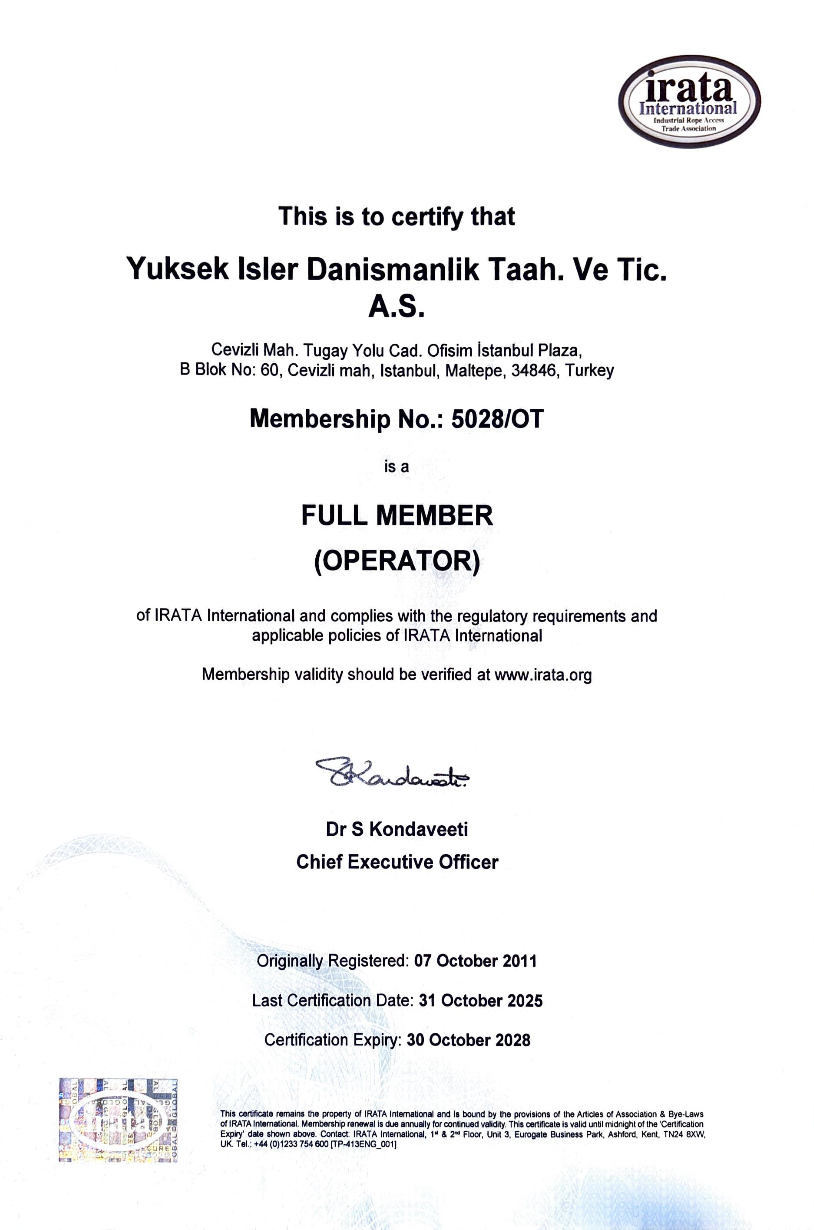
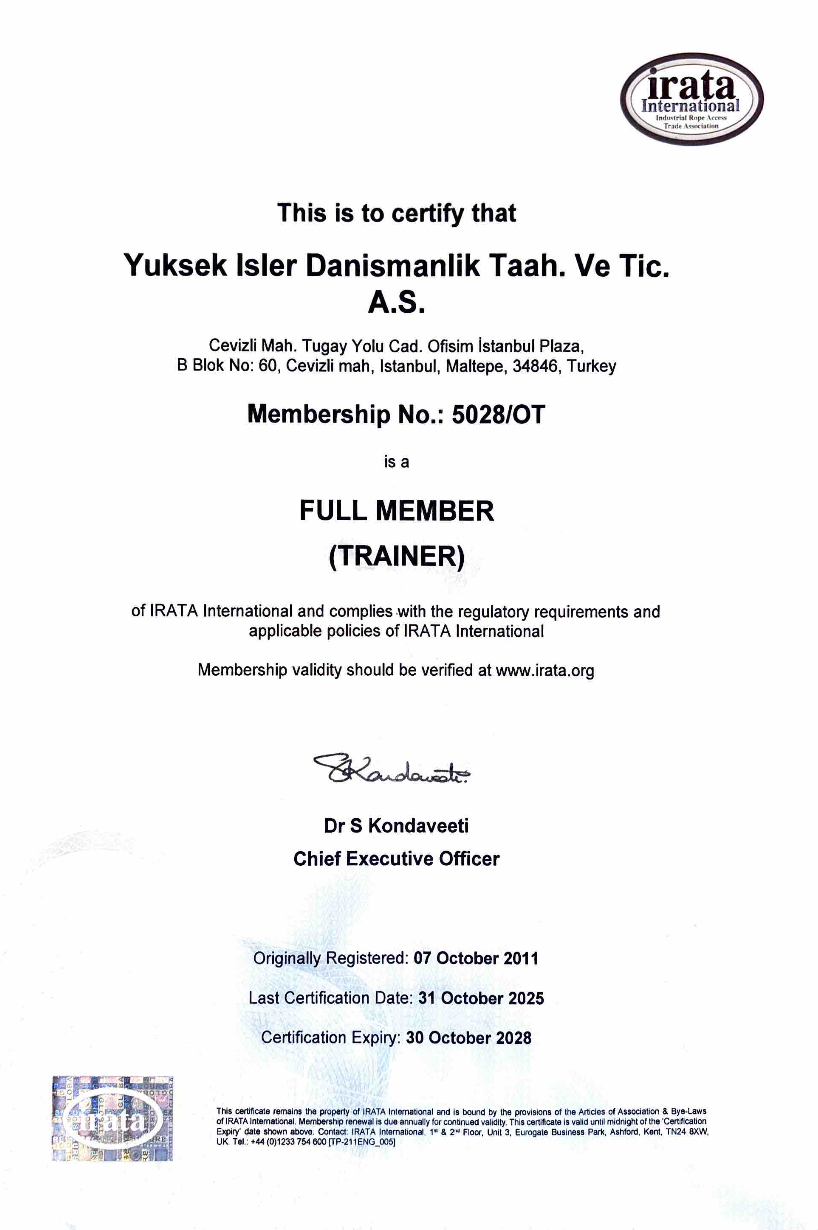
Since 2011, as a full member (Training & Operations) of IRATA, our company aims to ensure that personnel working at height or entering confined spaces are trained in accordance with current national and international standards. Our objective is to enable participants to work more safely on site and to increase their awareness of hazards and risks.
Training sessions are delivered by IRATA Level 3 certified Occupational Safety Specialists within Yüksek İşler (High Works). Participants who successfully complete the theoretical and practical examinations are awarded a “Certificate of Achievement” in accordance with Occupational Health and Safety Law No. 6331 and related regulations, while those who do not meet the success criteria are issued a “Certificate of Participation”.
Work at Height
Level 1

| Group Size: | 12 Participants / 1 Instructor |
| Duration: | 1 Day (8 Hours) |
CONTENT
The purpose of this course is to teach personnel with work experience the principles of working at height that they may encounter in easily accessible work areas and to raise awareness. Participants gain knowledge on fundamental topics such as the risks of working at height, relevant legislation, the use, inspection, and maintenance of Personal Protective Equipment (PPE), and risk assessment.
Participants who successfully complete the training acquire both theoretical and practical skills regarding fall arrest, work positioning, and fall restraint (lanyard) systems in line with their job descriptions.
PREREQUISITES
- Medical fitness to work in heavy and hazardous jobs
- Suitability for working at height
WHO SHOULD ATTEND
- Personnel working in simple tasks with easy access
- Personnel working on access equipment such as mobile platforms, scaffolding, cranes, and boom lifts
TRAINING CONTENT and OBJECTIVE
- Hazards of working at height
- Basic legal regulations
- Risk assessment
- Preparation of a safe working environment
- Lanyard usage
- Safe working practices
- Criteria for selecting the correct anchor (attachment) point
CERTIFICATION
Participants who successfully complete the theoretical and practical examinations are awarded a “Certificate of Achievement” in accordance with Occupational Health and Safety Law No. 6331 and related regulations. Participants who do not meet the required success criteria are issued a “Certificate of Participation”.
Work at Height
Level 2

| Group Size: | 12 Participants / 2 Instructors |
| Duration: | 2 Days (16 Hours) |
CONTENT
The purpose of this course is to teach personnel with work experience the principles of working at height that they may encounter in different and hazardous work environments, and to raise awareness. Participants gain knowledge on fundamental topics such as the risks of working at height, relevant legislation, the use, inspection, and maintenance of Personal Protective Equipment (PPE), and risk assessment.
Participants who successfully complete the training acquire both theoretical and practical skills related to fall arrest, work positioning, and fall restraint (lanyard) systems. In addition, they perform simple rescue scenarios and emergency evacuation practices using user-friendly equipment. Throughout the training, emphasis is placed on practical application and on developing solutions for various real-life scenarios encountered in the field.
PREREQUISITES
- Medical fitness to work in heavy and hazardous jobs
- Suitability for working at height
WHO SHOULD ATTEND
- Personnel working in heavy and hazardous jobs
- Personnel working on access equipment such as mobile platforms, scaffolding, cranes, and boom lifts
- Personnel working while attached to fixed anchor points
- Personnel working while connected to horizontal or vertical lifeline systems
- Those responsible for rescuing personnel suspended in accessible areas
TRAINING CONTENT and OBJECTIVE
- Principles of working at height (Fall arrest, fall restraint, work positioning)
- Basic legal regulations
- Risk assessment
- PPE inspection
- Lanyard usage
- Anchor point selection
- Use of fixed lifeline systems
- Installation and use of temporary horizontal and vertical lifeline systems
- Emergency planning
- Rescue of a suspended person at an accessible point
CERTIFICATION
Participants who successfully complete the theoretical and practical examinations are awarded a “Certificate of Achievement” in accordance with Occupational Health and Safety Law No. 6331 and related regulations. Participants who do not meet the required success criteria are issued a “Certificate of Participation”.
Rescue at Height
Training

| Group Size: | 12 Participants / 2 Instructors |
| Duration: | 2 Days (16 Hours) |
CONTENT
This training focuses on rescuing personnel working at height in accessible areas through different scenarios and ensuring their safe evacuation from the site during emergencies. The objective is to enable participants to act consciously when approaching an accident scene and to evaluate all possibilities before initiating a rescue.
The training is conducted without putting the rescuer at risk, using simple, user-friendly equipment and easy-to-remember methods. Emphasis is placed on controlled lowering and suspension rescue techniques. It does not cover descent or rope access scenarios requiring advanced rope techniques. Additionally, the training includes skills for safely evacuating towers, vehicles, or platforms in emergency situations.
PREREQUISITES
- Medical fitness to work in heavy and hazardous jobs
- Suitability for working at height
- Prior completion of Working at Height Level 2 Training
WHO SHOULD ATTEND
- Personnel working in heavy and hazardous jobs
- Personnel working on access equipment such as mobile platforms, scaffolding, cranes, and boom lifts
- Personnel working while attached to fixed anchor points
- Personnel working while connected to horizontal or vertical lifeline systems
TRAINING CONTENT and OBJECTIVE
- General rescue principles
- Rescue planning and risk assessment
- Emergency procedures
- Initial response to the casualty
- Rescue equipment and usage limitations
- Inspection and maintenance of rescue equipment
- Rescue of conscious / unconscious casualties
- Emergency evacuation from height
CERTIFICATION
Participants who successfully complete the theoretical and practical examinations are awarded a “Certificate of Achievement” in accordance with Occupational Health and Safety Law No. 6331 and related regulations. Participants who do not meet the required success criteria are issued a “Certificate of Participation”.
Gallery


Certificates